Importance and Care of Primary Teeth (Baby Teeth)
Baby teeth, also called primary teeth, are shed, but they are still very important for a number of reasons. Children need strong, healthy baby teeth in order to chew food properly, to pronounce words correctly, and to maintain space in the jaw for the permanent teeth. That is why it is important to take good care of the primary teeth by keeping them clean and healthy.
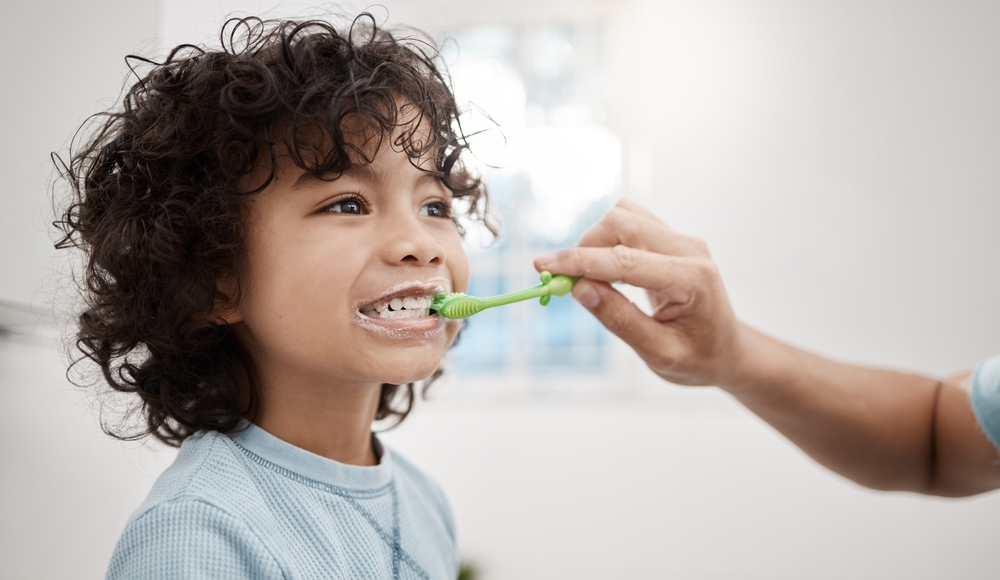
Even before the first tooth erupts, your child’s gums should be wiped gently with a wet cloth or gauze after every feeding. At the appearance of the first tooth, begin brushing your child’s teeth with water. Children older than 2 years should be supervised during brushing to ensure that only a pea-sized amount of fluoride toothpaste is used, and that the toothpaste is spit out rather than swallowed, and they rinse with water afterward.
Preventing Decay
Primary teeth, if not kept clean and healthy, can develop decay. This decay can lead to infection, which can damage permanent teeth. Tooth decay in infants and young children occurs when the teeth undergo frequent and extended exposure to liquids containing sugar. To keep your child’s teeth cavity-free and avoid oral pain, do not allow your child to fall asleep with a bottle containing anything other than water. Milk, formula, and juice, when given to a child right before they fall asleep, can remain on the teeth and in the mouth and cause tooth decay. If your child needs a pacifier between feedings or at bedtime, give them a clean pacifier. Do not give your child a pacifier dipped in honey or sugar.
Eruption of Primary Teeth (Baby Teeth)
Tooth eruption begins around the age of 6 months and can last until the age of 3 years. During this stage, your child’s gums may be sore and irritable. You can soothe them by gently rubbing the gums with a cold, wet cloth, the back of a cold spoon, or a clean finger.
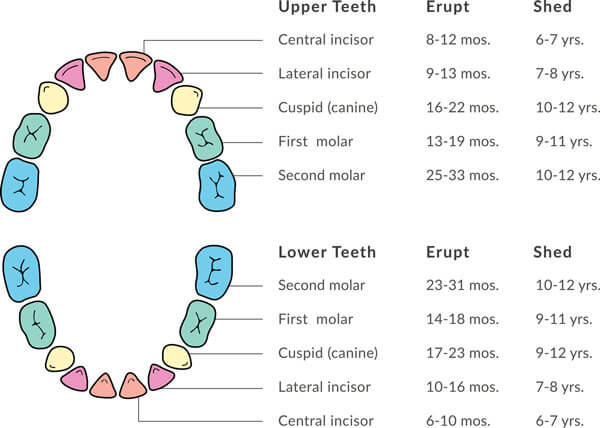
The timing and sequence for the eruption of a child’s 20 primary teeth (baby teeth) is as follows:
A child’s central teeth, both upper and lower, are the first to appear, and then other teeth erupt sequentially, moving toward the back of the arch. The exception to this is the first molars, which typically erupt before the cuspids (canines). The first teeth to erupt are the lower and upper central incisors, which erupt between the ages of 6 and 12 months. The next to erupt are the lateral incisors between 9-16 months, followed by the first molars from 13-19 months. Next, the cuspids (canines) erupt from 16 to 23 months. Lastly, between 23 and 33 months, the second molars erupt.
Baby Tooth Shedding
Children typically begin shedding their primary teeth at the age of 6 years, starting with the central incisors and followed about a year later by the lateral incisors. The first molars are shed next, closely followed by the lower canines. The upper canines and both upper and lower second molars are shed last.